July 8, 2009

Weebly

I’m thinking about using Weebly instead of WordPress. I have nothing against WordPress but Weebly seems very simple. What do you think of Weebly? Check out my site: http://nikimae.weebly.com/

June 9, 2009

Celebrities on Twitter

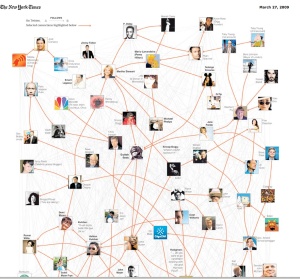
nytimestwitterEveryone is on Twitter, especially celebrities. Watching the playoffs, I had to laugh out loud when I heard Dwight Howard thank his Twitter followers. And then I had to add him. There are hundreds of different Web sites that give out “authentic” celebrity Twitter accounts, including CelebrityTweet, TIMES online and The Guardian online. But why are celebrities so hooked on Twitter? I’ve been thinking about this.

Celebrities usually want to keep their lives private, so why are they constantly updating their status on Twitter? Maybe it is a marketing technique for celebrities and it allows them to up their status in Hollywood — the person with the most followers is the most popular. Or it could be that Twitter allows them to share information with fans in a controlled way. Or maybe they are just doing because everyone is doing it. Could they simply be doing it because Twitter is… fun? Whatever the reason is, celebrities are joining at an alarming rate. 

However, it may not be all that it seems. Celebrities are joining Twitter, but they are also on other social networks like Facebook or Myspace. While hundreds of celebrities are on Facebook, it doesn’t seem to make as much of an impact as Twitter does. This is because of the social aspects of Twitter. Fans are able to follow and even interact with their favorite celebrities unlike Facebook and Myspace where there is a slight chance that their response is even looked at. Twitter allows “normal people” to get close with celebrities. Good for fans, good PR for celebrities. 

You can follow me on twitter: @nikimae

May 31, 2009

New Dreamweaver Web site

I just finished my first Web site! I am so excited. Check it out at http://uoregon.edu/~ninouye/portfolio/.

It was an assignment for my ART408 seminar, which focused on Adobe Dreamweaver. Our professor taught us the basics, and we had to apply everything we learned into our Web site. I decided to create an online Portfolio since I know it will come in handy now that I’m about to graduate. I recommend everyone taking some sort of Dreamweaver class. It’s a lot of fun to use the program (even though it can get frustrating at times), and I guarantee that you will feel accomplished when you are finished. Happy Web designing!

April 14, 2009

Informational Interviews


interview-reducedOver the past few months I’ve had the opportunity to have an informational interview with two prominent public relations professionals in Eugene, Ore. I wanted to share some key points that I learned from them.

I first interviewed Bridget Baker, Director of Corporate Public Relations at The Register-Guard. Ms. Baker described how the newspaper industry is severely affected by the economy and had a few recommendations for standing out from other grads trying to find a job. She strongly suggested learning Web design programs, such as Adobe Dreamweaver and believed that it is extremely important to know how to create and manage Web sites. She then told me that The Register-Guard is not hiring, except for in the area of Web design and management. Ms. Baker believed that although job opportunities are slim with the current economy, there are still Web-based jobs that are hiring. From this information I immediately enrolled myself in several ART408 seminars at the UO, which teach beginning, intermediate, and advanced Dreamweaver. It is extremely interesting (and fun), and I would recommend it for anyone who wants to learn Web design tools.

My second informational interview was with Monica Shovlin, Vice-President of the Ulum Group. From this informational interview, I received an internship interview that led to a part-time internship at which I am currently involved. Informational interviews are an outstanding and easy way to network and get your name out there. From this interview I learned more about the Ulum Group as an organization and discovered that it was a place that I wanted to gain experience from. Although public relations has been taking a hit from the economy, there are many companies still investing in PR because it is a cost effective way of creating awareness. Something that Monica felt was extremely important in public relations is knowledge of social media and how to use it in marketing. Everyone can use social media for personal use but it’s important (in the PR world) to know how to effectively use it for a company. From this advice, I decided to take a Social Media Marketing course at the UO to help me build these skills. 

I wanted to end this blog post with a list of the top 5 things I’d recommend to do at an informational interview:

5. Do your research. Make sure you know information about the person and the company before you go into the interview. Google them. It’s important that you go into the interview knowing basic information so that you aren’t asking irrelevant questions (and wasting you and the interviewer’s time). 

4. Dress nicely. Dress so that the company you are interviewing for would want you to work for them. When the situation comes, you’ll want to be more overdressed than underdressed.

3. Bring a polished copy of your resume and possibly a few writing samples to leave behind. Bring your portfolio. Even if you don’t end up giving them to your interviewer, it’s important to be prepared.

2. ASK QUESTIONS! This is why you are there! And don’t be afraid to ask certain question either. However, be reasonable and polite.

1. Lastly, make sure that you ask the interviewer two things: 1) Do you recommend anyone else to talk to? and 2) What can I do to present myself better? Both of these questions will not only show that you are professional and care about your doing, but they will help you in the future. Maybe this interview led to a dead-end but the next interview may lead to a job!

Don’t forget to send a thank you note and maintain contact after the interview.

January 12, 2009

Quick Update on my Life

Busy Woman

Busy Woman

It has been forever since I’ve written a post, I’m so sorry! This is going to be a quick little update on my life.

Right now I’m interning at the American Red Cross and the American Cancer Society. I am the publicity intern for the ACS, and I have a feeling that it is going to be a lot of work. I’m going to be doing the publicity for the Eugene Relay for Life as well as the UO Relay for Life. It will be an amazing experience, and I hope to build some great relationships with people in Eugene.

I’m also interning at the American Red Cross. This internship will be fun and not as stressful because it is very flexible. I’m going to be able to set my own hours and gain a wide range of experience. I’ve already created a PSA and a teaser for the local newspaper here. Very exciting.

I only have two more terms left here at the University of Oregon, and I’m a little stressed out. I need to start looking for a job and with this economy, I am feeling a bit worried. Classes this term are interesting. I’m taking two breadth classes for the journalism school as well as campaigns, the final public relations class in the sequence. In my campaigns class, we are put into groups and work with a real nonprofit organizations around Eugene. Our client is the Network Charter School, a charter school in this area. Their goal is to increase enrollment, and we as a group are figuring out ways to do this.

I have so many projects going on, it’s hard to keep them all straight! But I hope to write more blog posts in the near future. I’ll definitely be keeping updates on my projects including all my problems and successes. Check back soon!

December 3, 2008

PR Help?

thinking_woman4

I have a PR problem that I need help with.

A nonprofit organization that I intern at set a huge goal of fundraising a million dollars last year. They did not reach that goal. This year, they are trying to set a new goal, and they are contemplating setting a goal for a smaller, more reasonable amount of $800,000. Last year they brought in nearly $750,000.

Now, in the eyes of the public, does this look like a cop out? Does it look the the organization is giving up hope? Even though achieving a $800,000 goal would be outstanding, it still is less than the original. In my eyes, moving the goal downward is a bad sign.

But on the other side, it makes sense to set the goal at a reasonable amount. This lowered goal gives the organization an easier chance to achieve it. And, there is still the possibly of completely surpassing the goal.

Does anyone have any knowledge on what to do in this situation? I’m not sure what to do. As of right now, I’m leaning towards keeping the goal at a million dollars. Even though I don’t know if they will achieve this amount, I still feel that the higher goal will make people reach and strive to achieve it. What do you think?

November 23, 2008

The Point — Do you get it?

logo_wordsI’ve been working with a student organization (Oregon Direct Action) for the past couple weeks, and they’ve been coming up with different ways to fundraise for their group. One idea that I’ve never heard of was to use The Point, a Web site that helps you fundraise. 

This Web site is a little different from other fundraising sites. It is self described as “campaigns meet the tipping point.” From their Web site, “On The Point, all campaigns have a “tipping point” — people pledge to give money or do something, but no one does a thing until the conditions are met to make contributions worthwhile.” So basically, you don’t have to give money unless your fundraising goal is reached. That way people who are giving money know where their money is going. Makes sense!

I thought this Web site was a great idea. The student group wants to raise money to hire and send a sociologist to Peru for part of a project they are working on. But not all fundraising on The Point is serious. One member is going to make a birthday list and send it to her friends and family — she wants to raise up enough money so that she can travel to Peru with other members of the group. It’s very interesting to browse some of the campaigns that The Point hosts. You can search by channels, such as the environment, animals, artists, politics, or whatever you prefer.

It’s interesting how the Internet has become so multifaceted. You can do so much for your company or organization without leaving home. Not only is it more cost efficient (it doesn’t cost anything to put a post on The Point), but sometimes it’s a better way to reach your audience. Looking at some of the posts on The Point, many of them are directly related to college students. What a perfect way to reach their target audience! Please, take a look at The Point and see what you think. Does it look legitimate? Would you donate money to a cause on The Point?

November 18, 2008

Internships — Free labor?

internshipA couple of weeks ago, I came across a blog based off of the book “Stuff White People Like” (thanks for the tweet Ali!).  Post #105 was unpaid internships.

Although I don’t consider myself white — I am half Japanese and consider myself mixed — I feel like this post refers to me. Perhaps this blog post in particular can be extended to any young person in college, for I feel like most of the people around me strive to find internships relating to their future career.

Anyway, this blog wrote, “Young white people… prefer internships that put them on the path for careers that will generally result in a DECREASE of the material wealth accumulated by their parents.” This means that us young people would prefer an internship that relates to our career aspirations, and not get paid, to a job where we get paid — but is unrelated to our goals.

Of course we’d like the best of both these situations, a paid internship that relates to our field of study, but those are seeming harder and harder to find.

I just got accepted at two internships, both unpaid. Right now, I feel like this is the best fit for me. I get to shape my own hours, both of which I intern for less than 10 hours a week each — something that I wouldn’t have as much control over at a paid internship. My internships are both with nonprofit organizations, places where there isn’t much money in the first place. Even though I don’t get paid, I want to work in nonprofits when I graduate so the experience I’m getting is exactly what I need.

If you look at it from the other perspective, unpaid internships are free labor to the company or organization. Is this really fair? Many internships require a lot of work and effort out of the student, as much as any employee, but they are not getting paid. Hmm, what a dilemma.

In all, internships are very important for college students. You don’t want to graduate without any experience;  it would be much tougher to find a job. Personally, I feel like it’s more important to find an internship that fits your wants and needs than to find one that pays well. Maybe that’s just me.

Perhaps my colleagues feel differently. What do other college students think about unpaid internships?

November 16, 2008

Product placement. Can’t escape it!

Coca-Cola on American Idol

Coca-Cola on American Idol

As promised on my last blog entry, this post is going to be all about product placement in movies and TV. Anyone who has seen a movie or watched TV recently has been exposed to product placement. Unfortunately for consumers, it’s a new way for companies to drill their brand into the minds of the viewers. This Web site has some great examples of memorable product placements in movies.

One product placement that sticks out in my mind (thanks to the Web site) is Fed-Ex in Cast Away. Even though the plot isn’t focused on Fed-Ex, it is still a big part of the story. People remember from the movie that Tom Hanks works for Fed-Ex. Details such as these don’t seem like a big deal at first glance, but looking back at this movie now, it’s so obvious to me as to why Fed-Ex was in the movie. Fed-Ex is spreading the image of their product to everyone who watches the movie; what great brand management. With Tom Hanks and Helen Hunt as the leading actor and actress, this movie is bound to bring in a lot of viewers. Instead of paying for costly advertisements (that consumers ignore anyway), Fed-Ex put their product in a popular movie. People are making the effort — on their own — to watch the movie, but along with the movie, they also see your product. They don’t have a choice. This trend is not going to stop anytime soon. With TiVo and other DVRs, consumers are avoiding commercials completely. But by placing products into the shows themselves, they become unavoidable. Genius for companies, bad for the consumers.

Not every product placement gets a full-length feature in a movie like Fed-Ex did. Many companies, like in the image above with Coca-Cola, just have a quick scene with their product in a movie or TV show. I can’t even imagine how expensive it is to add products into big name shows and movies. To add to this, companies are paying huge amounts of money to reach the underlying goal of having their product look casual in the scenes. Consumers will not be interested in a show that has awkward product placement.

What do you think about product placement? Is it noticeable?

November 11, 2008

The use of public relations on reality television

thehills

The cast of The Hills

When I first had the idea to write this post it was going to be on a completely different aspect of reality TV and public relations. My focus was going to be on the reality television stars themselves. After reading a blog post on this same issue, it got me thinking about companies and products that put themselves on the reality television shows; this product placement.

I don’t watch many reality shows, but my favorite is The Hills. It’s addicting, especially because the girls are around my age, and they gossip and bicker like my friends (although not quite as extreme as this show). There has been some speculation recently that The Hills is scripted, but I am going to write this post as if it were a true reality show. Otherwise my opinions would change because rather than filming about her life and the companies in her life, these companies would be a direct product placement on the show.

Assuming the show is “real,” Lauren, the star of The Hills, starts out as intern at Teen Vogue. Although the company isn’t the focus of the show, Lauren works there and much of the show is filmed at her work. This show has gotten huge ratings and there is a ridiculous amount of Hills fans around the world. Seeing Lauren work at Teen Vogue makes Teen Vogue a hot spot and many of the fans will then become Teen Vogue fans because of this association (If this show isn’t real, perhaps that is why they focused on Teen Vogue rather than Vogue? To reach this younger audience?). After Teen Vogue, Lauren then began working at People’s Revolution. I’m not quite sure what People’s Revolution is but it looks super trendy, thanks to The Hills (Kudos to People’s Revolution- it’s a public relations, branding and marketing firm. Why is Lauren always folding clothes then?)

To get to the point, if you put your brand onto a successful show that targets your specific audience, it will do wonders for your company. If anything, it will spread awareness of your band to people who might not have heard of it. It’s interesting to think about, especially because I never noticed this before.

Looking at the other reality competition shows, like America’s Next Top Model (ANTM) or even Real World/Road Rules Challenge (Sorry, I watch a lot of MTV I guess), the contestants receive strategic prizes. The brands of these prizes are highlighted as well. I haven’t watch ANTM in a while, but I remember that the prize would be a contract with Covergirl and full-page spread in Seventeen Magazine. It’s pretty obvious who their target audience is. On the RW/RW Challenge, they’d win stereos, iPods and other big named items before they had a chance at the big prize. Because reality shows are trying to portray real people, these people are given items and jobs that they are supposed to have. We (the audience) should want these jobs and these items. These companies might have done a good job in the past of being sneaky with their products, but we are catching on!

What to learn from this? Reality television really is no good — but you knew this already.

Next post will talk about product placement in movies and other TV shows. Oh gosh. We can’t avoid ads and strategic messages anywhere!